The Molecular Weight Paradox:
Why Your Hyaluronic Acid Serum Might Be Causing Inflammation
Can Hydrating Serum Cause Inflammation
The Molecular Weight Paradox, and why your "deep-penetrating" hydration serum might actually be triggering inflammation and pigmentation.
As scientists of Amaylla R&D team, we have a confession to make: the skincare industry loves to take a beautiful biological truth and mutilate it for marketing. And nowhere is this more aggressively true than with Hyaluronic Acid (HA).
If you look at the back of your serum bottle right now, you might see brands bragging about "Nano-HA," "Oligo-HA," or "Ultra-Low Molecular Weight HA." They claim it penetrates deeper. They aren’t lying about the penetration. But they are completely ignoring the biology of what happens next.


Welcome to the R&D lab of Amaylla.
In this first installment of our Scientific Dossier on Hyaluronic Acid, we are talking about The Molecular Weight Paradox, and why your "deep-penetrating" hydration serum might actually be triggering inflammation and pigmentation.
Let's get into the core science.
1. The Core Mechanism: The Peacekeeper and The Panic Button
To understand HA, you have to stop thinking of it as just a sponge that holds water. In the human body, Hyaluronic Acid is a highly active cellular signaling molecule.
In healthy, uninjured skin, HA exists as a massive, long-chain polymer known as High Molecular Weight HA (HMW-HA). Think of it as a structural scaffolding. At a cellular level, these massive HA chains bind to and cross-link with a specific cell surface receptor called CD44.
When HMW-HA cross-links with CD44, it sends a continuous "Tissue Integrity Signal" to your immune system. It essentially whispers to your cells: "Everything is structurally sound. Do not panic. Keep calm." It is a master anti-inflammatory peacekeeper.
But what happens when you get a cut, a sunburn, or a chemical burn? Your tissue degrades. Enzymes called hyaluronidases rush in and chop that massive HMW-HA into tiny, broken fragments known as Low Molecular Weight HA (LMW-HA).
Your immune system recognizes these tiny fragments as a sign of tissue destruction. These LMW-HA fragments act as "Danger-Associated Molecular Patterns" (DAMPs). Instead of binding to the calming CD44 receptors, they bind to Toll-Like Receptors (specifically TLR2 and TLR4).
Binding to TLRs sounds the cellular alarm, triggering a massive, pro-inflammatory immune response.

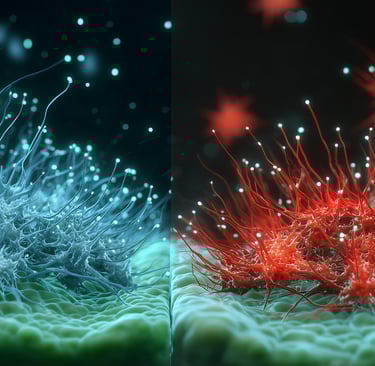
Image 1 - The Cellular Alarm - A microscopic 3D render of skin cell membrane. On the left side in blue; polymer chains (HMW-HA) are gently resting on calm receptor proteins (CD44). On the right side, the polymer chains are broken into jagged, tiny red LMW-HA that are crashing into aggressive receptor proteins TLR4 causing fiery cellular alarm.
2. The Bioavailability Reality Check: The Industry's Flawed Trick
Here is the formulation dilemma: HMW-HA is simply too large to penetrate the stratum corneum (the top layer of your skin). If you put it in a serum, it sits on top, forms a nice hydrating film, and washes off when you cleanse.
Brands know that consumers want "deep penetration." So, the industry took a shortcut. They chopped the HA into tiny pieces (LMW-HA or "Nano-HA") so it could bypass the skin barrier and get into the epidermis.
The brutal truth: By forcing ultra-low molecular weight HA into your living tissue, they are artificially delivering microscopic danger signals (DAMPs) straight to your cells. Your skin’s immune system detects these fragments, assumes your face is under attack, and triggers a low-grade, chronic inflammatory cascade.
3. The Indian Context: Why This is a Disaster for Melanin-Rich Skin
Why does this matter specifically for us in India?
Indian skin operates in a high-stress "Exposome." We deal with intense UV radiation, extreme heat, and severe particulate pollution. Your skin barrier is already fighting a daily battle against oxidative stress.
If you apply a concentrated serum of purely Low Molecular Weight HA, you are throwing a lit match into dry grass.
In melanin-rich skin (Fitzpatrick types III-V), what happens when the skin experiences chronic, low-grade inflammation? Post-Inflammatory Hyperpigmentation (PIH). The melanocytes overproduce pigment in response to the inflammatory trauma. Furthermore, chronic inflammation accelerates the breakdown of your natural collagen.
You bought a serum to look plump and radiant, but because the brand ignored the biology of TLR2/TLR4 signaling, you are potentially getting cellular panic, redness, and stubborn pigmentation.
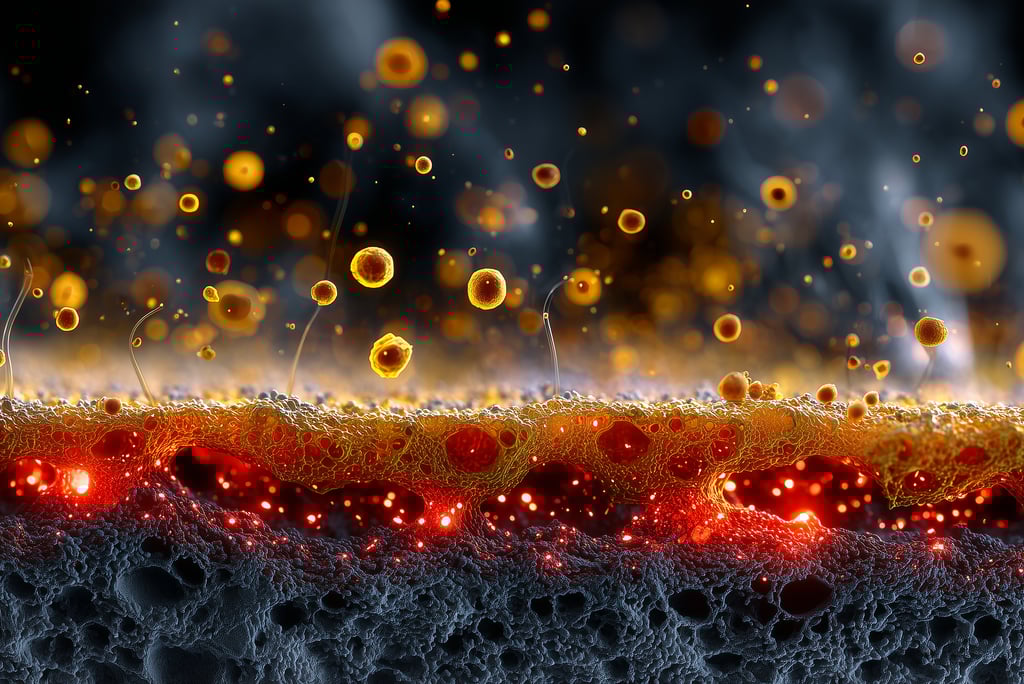
Image 2 - The Indian Exposome - Cross-section of skin under a microscope. The top layer is bombarded by UV rays, particulate pollution. Beneath the surface, melanin producing cells are reacting to a chaotic storm of LMW-HA triggering inflammation.
4. Our Formulation Rationale: Respecting the Barrier
This is exactly why we refuse to blindly formulate with isolated "Nano-HA."
In our products, we respect the CD44 pathway. We utilize precise, mid-to-high molecular weights designed to cross-link with CD44, signaling tissue integrity and actively calming the inflammatory response.
To achieve deeper hydration without triggering the TLR4 panic button, we don't chop the molecule into dangerous fragments. Instead, we use sophisticated delivery systems (which we will cover in Blog #3) to transport the right size of molecule exactly where it needs to go, while maintaining structural integrity.
We formulate for biological harmony, not for a marketing claim.
5. The Verification (Fact-Check Us)
Don't just take our word for it. We encourage you to look at the primary literature.
On the Danger Signals: Ruppert et al., "Tissue integrity signals communicated by high-molecular weight hyaluronan and the resolution of inflammation." Immunologic Research, 2014. (doi: 10.1007/s12026-014-8495-2)
On HA and Inflammation: Petrey & de la Motte, "Hyaluronan, a crucial regulator of inflammation." Frontiers in Immunology, 2014. (doi: 10.3389/fimmu.2014.00101)